NetArena Fork
Exploring AI agent benchmarks for network automation, from reproduction to wireless domain extension
Project Overview
This project forks NetArena (ICLR 2026) to study how AI coding agents perform on network automation tasks. Our goal is to reproduce the existing benchmarks, analyze the framework design, and extend it to wireless network optimization tasks that are currently absent from all existing benchmarks.
Progress Timeline
NetArena: Three Benchmark Tasks
NetArena evaluates LLM agents on three network automation tasks. In all three cases, the abstract pattern is the same: the agent receives a natural language task description plus access to a network environment, and must produce an action (code, command, or configuration) that changes the environment to a desired state.
| App | Domain | Input | Output | Verification |
|---|---|---|---|---|
| Route | L3 Routing | A broken network topology in Mininet + description of the symptom (e.g., H1 cannot reach H3) | Diagnosis of the misconfiguration + corrective commands to fix routing | After fix: ping succeeds, traceroute shows correct path |
| MALT | Data Center | A data center topology graph + natural language instruction (e.g., add a switch under node X) | Python code that manipulates the topology graph using networkx | Execute code, compare resulting graph against ground truth |
| K8s | Cloud Native | A running Kubernetes cluster + access control requirement (e.g., isolate namespace A from B) | Kubernetes NetworkPolicy YAML configuration | Apply policy, test that allowed traffic passes and blocked traffic is denied |
Input:   Natural language task  +  Network environment state
            |                           |
            v                           v
Agent:   Understand the goal    +  Read current state
            |
            v
Output:  Action (code / command / config)
            |
            v
Verify:  Execute action in environment, check desired state reached
         Score on: Correctness + Safety + Latency
All three tasks operate on wired networks and IT infrastructure. Wireless resource allocation, physical layer optimization, UAV trajectory planning, spectrum management, and network slicing are entirely absent. This is the gap we aim to fill.
App-Route: 路由故障排查
Agent 拿到一个用 Mininet 搭建的虚拟网络,网络里有一个路由配置错误导致某些主机之间不通。Agent 需要先读取网络状态(路由表、接口配置),判断哪里配错了,然后输出修复命令。评测端执行命令后检查 ping 是否恢复、路径是否正确。
输入:一个有故障的网络 + "H1 无法 ping 通 H3"
输出:修复命令(比如修改某条静态路由的下一跳地址)
验证:修复后 ping 成功 + 路由路径正确
App-MALT: 数据中心容量规划
Agent 拿到一个数据中心的拓扑图(用 networkx 图表示,包含交换机、端口、机架的层级关系),以及一条自然语言指令。Agent 需要生成 Python 代码来操作这个图,比如添加设备、删除端口、查询统计信息。评测端执行代码后,对比结果图和标准答案图。
输入:数据中心拓扑图 + "在 ju1.s4.dom 下添加一台交换机"
输出:Python 代码(调用 networkx API 操作图)
验证:执行代码,对比输出图与标准答案
App-K8s: Kubernetes 网络策略配置
Agent 拿到一个运行中的 K8s 集群,以及一条访问控制需求。Agent 需要生成 NetworkPolicy YAML 配置来实现 Pod 之间的网络隔离。评测端将配置应用到集群后,检查允许的流量能通、禁止的流量被拦截。
输入:K8s 集群 + "禁止 namespace-A 的 Pod 访问 namespace-B 的数据库"
输出:NetworkPolicy YAML 文件
验证:应用策略后,测试流量是否按预期通断
三个任务的共同模式
自然语言任务描述 + 网络环境当前状态
        |
        v
Agent 理解目标 + 读取环境
        |
        v
生成动作(代码 / 命令 / 配置文件)
        |
        v
在环境中执行动作
        |
        v
检查:正确性 + 安全性 + 响应时间
三个任务都是有线网络和 IT 基础设施。无线资源分配、UAV、频谱管理等方向完全没有覆盖。
How NetArena MALT Works (Detail)
MALT evaluates whether an LLM can act like a network engineer: understand a task instruction in natural language, then write correct Python code to manipulate a data center network topology graph.
Example Task
"Add new node with name new_EK_PACKET_SWITCH_9 type EK_PACKET_SWITCH, to ju1.s4.dom. Return a graph."
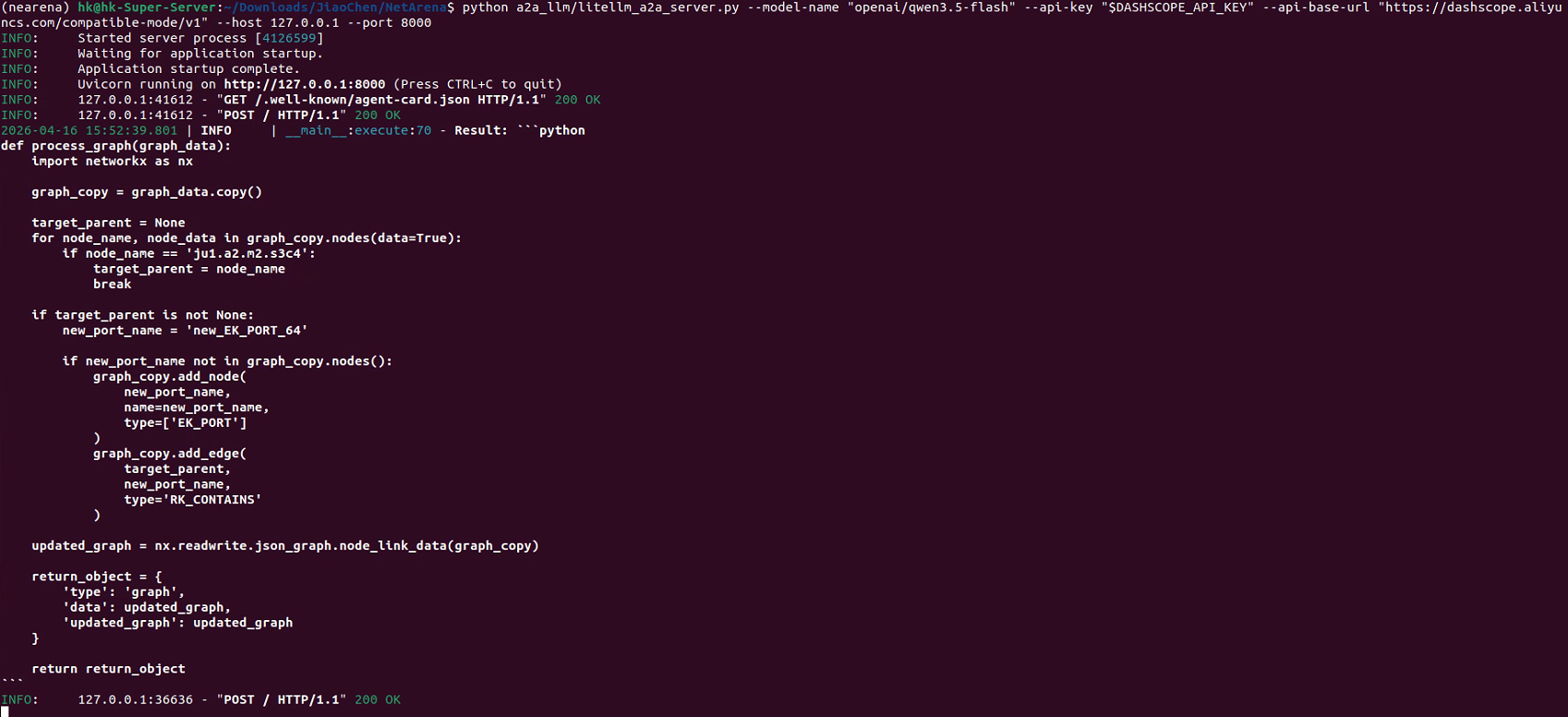
def process_graph(graph_data):
    import networkx as nx
    graph_copy = graph_data.copy()
    target_parent = 'ju1.s4.dom'
    graph_copy.add_node('new_EK_PACKET_SWITCH_9',
                        type=['EK_PACKET_SWITCH'])
    graph_copy.add_edge(target_parent,
                        'new_EK_PACKET_SWITCH_9',
                        type='RK_CONTAINS')
    return {'type': 'graph', 'data': graph_copy}
| Correctness | Was the node added correctly? Right type? Right parent? |
| Safety | Were any existing nodes or edges accidentally deleted? |
| Latency | How long did the agent take to respond? |
End-to-End Flow
Benchmark App                    Agent Server                 LLM API
     |                               |                          |
     |-- "Add switch to node X" ---->|                          |
     |                               |-- forward task --------->|
     |                               |                          |
     |                               |<-- return Python code ---|
     |<-- return code ---------------|                          |
     |                               |                          |
     | Execute code in simulator                                |
     | Compare result vs ground truth                           |
     | Output: Correct/Wrong + Safe/Unsafe + Latency            |
Three Difficulty Levels
| Level | Operations | Count | Example |
|---|---|---|---|
| Level 1 | add, list, rank, remove | 2000 | Add a switch under node X |
| Level 2 | remove + count/list/rank | 1500 | Remove all ports, then count remaining |
| Level 3 | add + count/list/rank | 1500 | Add 3 switches, then sort by name |
Think of it as a coding exam: the question is "use Python to operate a graph database", the student (LLM) writes code, the examiner (benchmark) runs the code and checks against the answer key. NetArena generates exam questions dynamically so the LLM cannot memorize answers.
MALT Reproduction Results
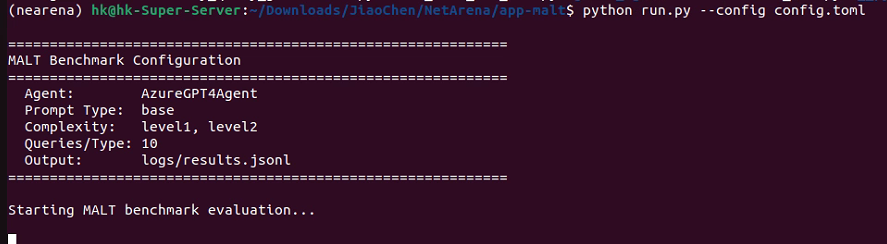
| Benchmark | MALT (Data Center Capacity Planning) |
| Agent | Qwen3.5-Flash via DashScope |
| Server | Ubuntu 22.04, 40 cores, 62GB RAM, NVIDIA GPU |
| Complexity | Level 1, Level 2 |
| Protocol | A2A (Agent-to-Agent) |
Existing Benchmark Landscape
| Benchmark | Venue | Tasks | Simulator | Domain |
|---|---|---|---|---|
| NetArena | ICLR 2026 | Route, MALT, K8s | Mininet, Custom | Wired / IT |
| NetLLMBench | IEEE 2025 | BGP, OSPF, Static | Containerlab + FRR | Wired L3 |
| LLM4NetLab | SIGCOMM 2025 | Fault diagnosis | Containerlab + FRR | Wired L3 |
All three benchmarks focus exclusively on wired network configuration (L3 routing, data center, Kubernetes). No existing benchmark covers wireless network optimization tasks such as power control, UAV trajectory planning, beamforming, spectrum management, or network slicing.
Proposed Extension: Wireless Tasks
| Task | Domain | Difficulty | Simulator | Status |
|---|---|---|---|---|
| Power Control | Resource Allocation | Medium | Pure Python | Planned |
| UAV Trajectory Optimization | Coverage | Hard | UavNetSim / Python | Planned |
| Beamforming Design | Physical Layer | Hard | Pure Python | Planned |
| Spectrum Management | Resource Allocation | Medium | Pure Python | Planned |
| Network Slicing | Orchestration | Hard | Pure Python | Planned |
| Energy-Efficient Scheduling | Green Networking | Medium | Pure Python | Planned |
Related Work
Papers Referenced
| Paper | Venue | Relevance |
|---|---|---|
| Intent-LLM (VipeeGPT) | IEEE TCCN 2025 | LLM code generation for network config via Python API |
| LLM for Telecom Survey | IEEE COMST 2025 | Comprehensive survey of LLM applications in telecom |
| PC-LLM | arXiv 2024 | LLM for wireless power control |
| BeamAgent | arXiv 2025 | LLM-aided MIMO beamforming |
| SIMCODE | arXiv 2025 | NL to ns-3 simulation code benchmark |
Quick Start
# Clone and setup
git clone git@github.com:tenderzada/NetArena.git
cd NetArena
conda create -n netarena python=3.12 -y
conda activate netarena
pip install -e .
pip install litellm loguru "a2a-sdk[http-server]" uvicorn cattrs tomli httpx jsonlines prototxt_parser scipy

# Terminal 1: Start Agent Server
export DASHSCOPE_API_KEY=sk-xxx
python a2a_llm/litellm_a2a_server.py \
  --model-name "openai/qwen3.5-flash" \
  --api-key "$DASHSCOPE_API_KEY" \
  --api-base-url "https://dashscope.aliyuncs.com/compatible-mode/v1" \
  --host 127.0.0.1 --port 8000

# Terminal 2: Run Benchmark
cd app-malt
cp config.template.toml config.toml
python run.py --config config.toml